

Hey there! As a calcium formate supplier, I often get asked about how calcium formate reacts with acids. It's a pretty interesting topic, and today, I'm gonna break it down for you in a way that's easy to understand.
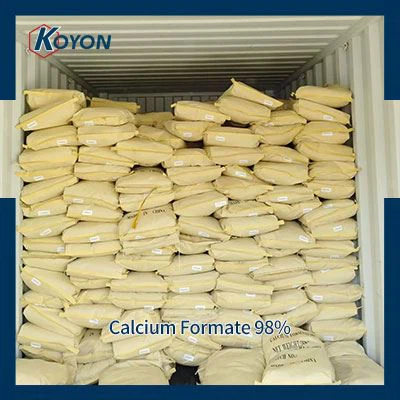
First off, let's talk a bit about calcium formate itself. Calcium formate has the chemical formula Ca(HCOO)₂. It's a white crystalline powder that's soluble in water. We offer two main types: Feed Grade Calcium Formate and Industrial Grade Calcium Formate. The feed - grade one is used in the animal feed industry to improve the performance of livestock, while the industrial - grade is used in various industrial applications like cement additives and leather tanning.
Now, when it comes to the reaction with acids, the basic principle is a typical acid - base reaction. Calcium formate is a salt of a weak acid (formic acid, HCOOH) and a strong base (calcium hydroxide, Ca(OH)₂). When it reacts with an acid, the formate ion (HCOO⁻) in calcium formate will react with the hydrogen ions (H⁺) from the acid.

Let's take hydrochloric acid (HCl) as an example. The chemical reaction between calcium formate and hydrochloric acid can be represented by the following equation:
Ca(HCOO)₂ + 2HCl → CaCl₂+ 2HCOOH
In this reaction, the calcium formate reacts with hydrochloric acid to form calcium chloride (CaCl₂) and formic acid (HCOOH). The formate ions in calcium formate combine with the hydrogen ions from hydrochloric acid to produce formic acid, and the calcium ions combine with the chloride ions to form calcium chloride.
The reaction is exothermic, which means it releases heat. You can actually feel a slight increase in temperature when the reaction occurs, especially if you're doing it on a larger scale. The rate of the reaction depends on several factors, such as the concentration of the acid, the temperature, and the surface area of the calcium formate.
If the acid is a stronger one, like sulfuric acid (H₂SO₄), the reaction is a bit more complex. The reaction equation is:
Ca(HCOO)₂ + H₂SO₄ → CaSO₄+ 2HCOOH
Here, calcium formate reacts with sulfuric acid to form calcium sulfate (CaSO₄) and formic acid. Calcium sulfate is a sparingly soluble salt, and it may precipitate out of the solution as the reaction progresses.
The reaction with nitric acid (HNO₃) follows a similar pattern:
Ca(HCOO)₂ + 2HNO₃ → Ca(NO₃)₂+ 2HCOOH
In this case, calcium formate reacts with nitric acid to produce calcium nitrate (Ca(NO₃)₂) and formic acid. Calcium nitrate is highly soluble in water, so it will remain in the solution.
These reactions are not just theoretical. In industrial processes, they can be quite useful. For example, in the production of formic acid, reacting calcium formate with a suitable acid is one of the common methods. The formic acid produced can then be used in various applications, such as in the textile industry for dyeing and finishing, and in the rubber industry for coagulating latex.
In the feed - grade calcium formate, the reaction with acids in the animal's stomach can also have an important role. When animals consume feed containing calcium formate, the acid in the stomach will react with it. This can help to lower the pH in the digestive tract, which is beneficial for the growth of beneficial bacteria and can also improve the digestibility of nutrients.
Now, you might be wondering about the safety aspects of these reactions. When handling acids and calcium formate, it's important to take proper safety precautions. Acids are corrosive, and some of the products of the reactions, like concentrated formic acid, can also be harmful. So, make sure to wear appropriate protective equipment, such as gloves and goggles, when working with them.
If you're in an industry that involves using calcium formate or is interested in the products of its reaction with acids, then you might want to consider getting in touch with a reliable supplier. That's where we come in. We've been in the calcium formate supply business for a while, and we offer high - quality products at competitive prices.
Whether you need Feed Grade Calcium Formate for your animal feed production or Industrial Grade Calcium Formate for your industrial applications, we've got you covered. Our products are tested to ensure they meet the highest quality standards.
If you're interested in purchasing calcium formate or have any questions about its reactions with acids or other properties, don't hesitate to reach out. We're always ready to have a chat and provide you with all the information you need. Let's start a conversation and see how we can work together to meet your calcium formate needs.
References
- Chang, R. (2020). Chemistry. McGraw - Hill Education.
- Housecroft, C. E., & Sharpe, A. G. (2018). Inorganic Chemistry. Pearson.