

Maleic anhydride is a versatile chemical compound widely used in various industries, including plastics, coatings, and pharmaceuticals. One of the important aspects of its reactivity is its interaction with bases. In this blog post, we'll explore how maleic anhydride reacts with bases, the underlying mechanisms, and the significance of these reactions in industrial applications. As a maleic anhydride supplier, we understand the importance of these chemical reactions and are here to provide high - quality products for your specific needs.
Structure and Reactivity of Maleic Anhydride
Maleic anhydride has a cyclic structure with a five - membered ring containing two carbonyl groups. The presence of these electron - withdrawing carbonyl groups makes the anhydride highly reactive. The cyclic structure also contributes to its reactivity, as the ring strain can be relieved during chemical reactions.
The reactivity of maleic anhydride is mainly due to the electrophilic nature of the carbon atoms in the carbonyl groups. Bases, on the other hand, are electron - rich species. When a base comes into contact with maleic anhydride, a reaction occurs due to the attraction between the electron - rich base and the electron - deficient carbon atoms in the anhydride.
Reaction Mechanisms with Bases
Hydrolysis with Hydroxide Bases
One of the most common reactions of maleic anhydride with bases is hydrolysis. When maleic anhydride reacts with a hydroxide base such as sodium hydroxide (NaOH), the reaction proceeds as follows:
The hydroxide ion (OH⁻) acts as a nucleophile and attacks one of the carbonyl carbon atoms of maleic anhydride. This attack breaks the carbon - oxygen double bond in the carbonyl group, and the electrons are pushed onto the oxygen atom, forming a tetrahedral intermediate.
The tetrahedral intermediate then undergoes a rearrangement. The oxygen atom with the negative charge reforms a double bond with the carbon atom, and the other oxygen atom in the anhydride ring is protonated. This results in the opening of the anhydride ring and the formation of maleic acid or its corresponding salt, depending on the reaction conditions.
If the reaction is carried out in an aqueous solution with an excess of hydroxide base, the maleic acid formed will react further with the base to form a maleate salt. For example, with sodium hydroxide, disodium maleate is formed:

$C_4H_2O_3+2NaOH\rightarrow Na_2C_4H_2O_4 + H_2O$
This hydrolysis reaction is important in many industrial processes. For example, in the production of certain polymers, maleic anhydride is first hydrolyzed to maleic acid, which can then be used as a monomer or a cross - linking agent.
Reaction with Amine Bases
Maleic anhydride also reacts readily with amine bases. When an amine reacts with maleic anhydride, the nitrogen atom in the amine acts as a nucleophile and attacks one of the carbonyl carbon atoms of the anhydride.
The reaction proceeds through a similar mechanism as hydrolysis. The amine attacks the carbonyl carbon, forming a tetrahedral intermediate. The intermediate then rearranges, and the anhydride ring opens. The product of this reaction is an amic acid.
The amic acid can further react under certain conditions, such as heating, to form an imide. This reaction is widely used in the production of polyimides, which are high - performance polymers with excellent thermal and mechanical properties.
For example, when maleic anhydride reacts with aniline ($C_6H_5NH_2$), the initial product is an amic acid:
$C_4H_2O_3 + C_6H_5NH_2\rightarrow C_6H_5NHCOCH = CHCOOH$
Upon heating, this amic acid can be converted to N - phenylmaleimide:
$C_6H_5NHCOCH = CHCOOH\rightarrow C_6H_5N(CO)_2C_2H_2+H_2O$
Significance in Industrial Applications
Polymerization
The reactions of maleic anhydride with bases play a crucial role in polymerization processes. As mentioned earlier, the hydrolysis of maleic anhydride to maleic acid is a key step in the production of some polymers. Maleic acid can be copolymerized with other monomers to form polymers with unique properties.
In the case of reactions with amines, the formation of imides is important for the production of high - performance polymers such as polyimides. Polyimides are used in aerospace, electronics, and other high - tech industries due to their excellent thermal stability, mechanical strength, and chemical resistance.
Adhesives and Coatings
The products obtained from the reactions of maleic anhydride with bases can also be used in adhesives and coatings. For example, maleate salts can be used as additives in water - based adhesives to improve their adhesion properties. The reaction products with amines can be used in the formulation of high - performance coatings that can withstand harsh environmental conditions.
Comparison with Other Anhydrides
Maleic anhydride is not the only anhydride used in industrial applications. Other anhydrides such as Trimellitic Anhydride and Pyromellitic Dianhydride also react with bases, but their reaction mechanisms and products may differ.
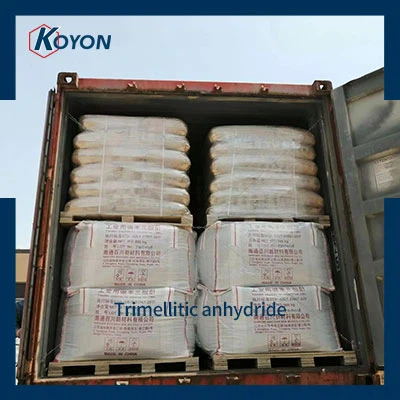
Trimellitic anhydride has a more complex structure with three carbonyl groups in a benzene - like ring. Its reaction with bases can lead to the formation of different types of carboxylic acids and salts, depending on the reaction conditions. The reaction mechanisms are also more complex due to the presence of multiple reactive sites.
Pyromellitic dianhydride has two anhydride groups in a single molecule. When it reacts with bases, the reaction can occur at both anhydride groups, leading to the formation of more complex products such as polycarboxylic acids or polyimides with different cross - linking densities.
Industrial Supply and Availability
As a Maleic Anhydride supplier, we are committed to providing high - quality maleic anhydride to meet the diverse needs of our customers. Our maleic anhydride is produced using state - of - the - art manufacturing processes, ensuring high purity and consistent quality.
We understand the importance of these reactions in various industrial applications, and our technical support team is available to assist you in understanding the reaction mechanisms and optimizing your processes. Whether you are involved in polymer production, adhesive formulation, or any other industry that uses maleic anhydride, we can provide the right product and support.
Conclusion
The reactions of maleic anhydride with bases are complex and have significant industrial applications. The hydrolysis with hydroxide bases and the reaction with amine bases are two important reaction pathways that lead to the formation of useful products such as maleic acid, maleate salts, amic acids, and imides.
These products are used in a wide range of industries, including polymers, adhesives, and coatings. Understanding the reaction mechanisms is crucial for optimizing industrial processes and developing new products.
If you are interested in purchasing maleic anhydride for your industrial needs or have any questions about its reactions with bases, please feel free to contact us for further discussion and procurement negotiations. We look forward to working with you to meet your chemical requirements.
References
- March, J. Advanced Organic Chemistry: Reactions, Mechanisms, and Structure. Wiley, 2007.
- Odian, G. Principles of Polymerization. Wiley, 2004.
- Kirk - Othmer Encyclopedia of Chemical Technology. Wiley, various editions.