

Yo, what's up! As a supplier of anhydrides, I've got some cool insights to share about the mass spectrometry features of these compounds. Mass spectrometry is like a super - detective tool in the chemistry world, helping us figure out what's going on at the molecular level. So, let's dive right in!

First off, what are anhydrides? Anhydrides are compounds that are formed when two carboxylic acid molecules lose a water molecule. They're pretty important in a bunch of industries, from making plastics to pharmaceuticals. And that's where we come in as suppliers, providing high - quality anhydrides to meet different needs.
Now, let's talk about how mass spectrometry works with anhydrides. Mass spectrometry is all about measuring the mass - to - charge ratio (m/z) of ions. When we analyze an anhydride using mass spectrometry, we first need to ionize it. There are different ways to do this, like electron ionization (EI) or electrospray ionization (ESI).
In electron ionization, a beam of high - energy electrons is used to knock an electron off the anhydride molecule, creating a positively charged ion. This ion then breaks apart into smaller fragments, and the mass spectrometer measures the m/z of these fragments. The resulting mass spectrum is like a fingerprint of the anhydride.
One of the key features we often see in the mass spectra of anhydrides is the presence of a molecular ion peak. This peak represents the intact anhydride molecule with a single positive charge. However, the intensity of the molecular ion peak can vary depending on the type of anhydride.
For example, in simple anhydrides, the molecular ion peak might be relatively strong. But in more complex anhydrides, the molecular ion might be less stable and break apart more easily, resulting in a weaker molecular ion peak.
Another important feature is the fragmentation pattern. Anhydrides tend to break apart in characteristic ways. One common fragmentation pathway is the loss of a carbonyl group (CO). This results in a fragment with a lower m/z value. The loss of CO is often seen in the mass spectra of many anhydrides and can be a useful diagnostic tool.
Let's take a look at some specific anhydrides. Pyromellitic Dianhydride is a widely used anhydride in the production of high - performance polymers. Its mass spectrum shows a complex fragmentation pattern due to its highly symmetric and rigid structure. The molecular ion peak might not be very intense because the molecule is prone to fragmentation. But by analyzing the fragments, we can still identify the compound.
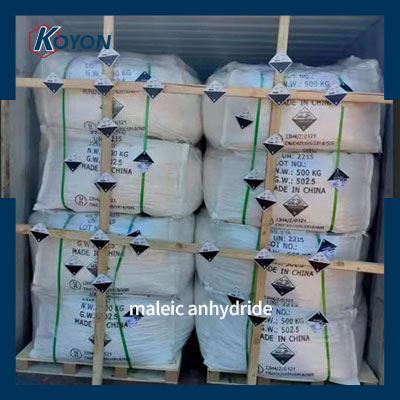
Maleic Anhydride is another well - known anhydride. It has a relatively simple structure compared to pyromellitic dianhydride. In its mass spectrum, the molecular ion peak is usually more prominent. The fragmentation pattern shows characteristic losses, such as the loss of CO and other small fragments. This makes it easier to identify maleic anhydride using mass spectrometry.
Trimellitic Anhydride is used in the production of plasticizers and coatings. Its mass spectrum also has unique features. The molecular ion peak and the fragmentation pattern can provide valuable information about the purity and structure of the compound. For instance, if there are impurities in the trimellitic anhydride sample, they will show up as additional peaks in the mass spectrum.
The mass spectrometry features of anhydrides can also be affected by the presence of substituents. If an anhydride has functional groups attached to it, these groups can influence the stability of the molecular ion and the fragmentation pathways. For example, an anhydride with a bulky substituent might have a different fragmentation pattern compared to an unsubstituted anhydride.
In addition to the structural information, mass spectrometry can also be used to determine the purity of anhydrides. Impurities in an anhydride sample will have their own unique mass spectra. By comparing the mass spectrum of the sample with that of a pure anhydride, we can detect and quantify the impurities. This is crucial for ensuring the quality of the anhydrides we supply.
We, as an anhydrides supplier, rely on mass spectrometry and other analytical techniques to guarantee the quality of our products. Our customers can be confident that the anhydrides they receive are of the highest purity and meet their specific requirements.
If you're in the market for high - quality anhydrides, whether it's pyromellitic dianhydride, maleic anhydride, trimellitic anhydride, or other types, we're here to help. We've got a wide range of anhydrides in stock and can provide custom - made solutions if needed. Just reach out to us for a quote and let's start a great business relationship.
In conclusion, mass spectrometry is an amazing tool for understanding the structure and purity of anhydrides. The molecular ion peak and fragmentation patterns in the mass spectra give us valuable insights into these compounds. And as a supplier, we use this knowledge to ensure that we're providing the best products to our customers. So, if you're interested in anhydrides for your projects, don't hesitate to contact us for more information and to discuss your procurement needs.
References
- Silverstein, R. M., Webster, F. X., & Kiemle, D. J. (2014). Spectrometric Identification of Organic Compounds. Wiley.
- McLafferty, F. W., & Tureček, F. (1993). Interpretation of Mass Spectra. University Science Books.